For sensitive skin, judge the whole garment: verified fibers, seams, labels, elastic contact and your own known tolerances. Bamboo-derived viscose is not an automatic hypoallergenic choice or an eczema treatment. Check medical guidance relevant to your condition, then choose adult fit and construction you find comfortable. A certification or soft fabric description cannot guarantee that a particular person will tolerate the pajamas.
Fabric softness is only part of skin comfort. A neck label, waistband seam or line of decorative piping can sit exactly where you find contact bothersome. Start with clothing you already tolerate and use its inside construction as a reference.
As an Amazon Associate I earn from qualifying purchases. Purchases take place on Amazon.
Options for this specific choice
These are clothing designs to inspect, not recommendations for eczema or other skin conditions. Rayon or spandex may be unsuitable for some readers; see the skin-specific guidance below. How we choose products.

NACHILA men’s V-neck pants set
NACHILA's long-sleeve V-neck top and pants can be compared with a familiar outfit, including where its seams and waistband touch.
Check AmazonView design & fit details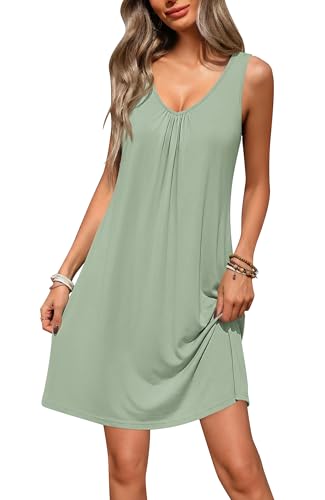
Ekouaer sleeveless nightgowns
Ekouaer's sleeveless nightgown avoids a separate trouser waistband; check the armholes and interior seams if those areas bother you.
Check AmazonView design & fit detailsAs an Amazon Associate I earn from qualifying purchases. Purchases take place on Amazon.
Set the medical boundary before choosing a material
The American Academy of Dermatology’s guidance for nummular eczema recommends soft, breathable, loose clothing and identifies cotton as an option. It also lists rayon and spandex among materials that can trigger flare-ups for this condition. This matters because many pajamas marketed as bamboo use rayon or viscose blends. That guidance does not mean everyone will react to them, but it prevents us from presenting this category as an automatic eczema solution.
Map the contact points on a garment you already tolerate
Start with a comfortable piece already in your drawer and inspect what makes its construction workable for you. Where is the neck opening? Does the waistband lie flat? Are the seams positioned away from the places you find bothersome? Use it as a design reference, not proof that every garment sharing its fiber will feel the same.
For a top, examine the neck edge, shoulder and underarm joins, sleeve opening and any button placket. A decorative pocket can add stitching inside the chest area even when the outer surface looks simple. Piping may create a raised line at an edge. These details are not inherently unsuitable, but they deserve attention if they fall at a contact point you already prefer to keep smooth.
For trousers, inspect the inside waistband, drawstring exits, pocket bags, crotch join and cuffs. A broad-looking waistband in an exterior photo may conceal elastic or a seam that changes the interior feel. Ask for an inside view when the construction is central to your purchase. It is better to leave the detail unknown than to infer comfort from the width of a color band.
Use product photographs as questions, not proof of comfort
| Visible detail | Question to ask | Why the answer helps |
|---|---|---|
| Neck label | Is it printed, sewn in or attached through a structural seam? | Identifies a contact point and whether removal may be complicated. |
| Decorative piping | What does the inner edge look like? | Clarifies whether the decoration adds an interior ridge. |
| Elastic waistband | Is elastic enclosed, and how is the inside finished? | Provides construction information beyond the outer silhouette. |
| Drawstring and pockets | Where do knots, exits and pocket layers sit? | Helps compare bulk at your usual resting positions. |
Do not assume “tagless” means an entirely featureless interior. A top may use a printed neck label while retaining side-seam information or other internal details. Likewise, a seller describing soft fabric may not be describing the seams at all. Separate the panel’s texture from the construction features you need to evaluate.
Adult ease should remove a problem without creating another
For adult pajamas, check comfort in a normal seated position as well as standing. A waistband that feels acceptable upright may fold when you sit; a collar can contact the neck differently when you lie back. These are ordinary fit observations you can make without treating the garment as a clinical test. Follow any instructions from your own clinician that apply to clothing choice.
This adult discussion must not be applied to children’s snug-fit sleepwear. The CPSC explains specific conditions for tight-fitting children’s sleepwear. A child’s exact garment labels and fit requirements govern the purchase. Do not add growing room or substitute adult loose-fit reasoning because a fabric is described as comfortable.
Understand what a certification actually adds
For a sensitivity concern, ask what a claimed textile label actually answers. An OEKO-TEX STANDARD 100 claim can be checked using the identifying information in Label Check, but it is not a promise that your skin will tolerate the finished pajama. Verify that the record covers the item, then continue checking the seams, elastic and care products relevant to your own experience.
For the difference between substance testing and environmental claims, see our textile certification guide.
If a seam or label is physically bothersome, first check whether the garment can be returned or whether the maker supports an alteration. Do not cut through stitching simply to remove a small label. A repair professional can assess construction if you decide to keep the item. Removing one visible feature should not leave a rough edge or an opened seam in the same contact area.
Inspect the fibers and laundry routine as well as the seams
Keep every listed blend component in your comparison. If you know you avoid a fiber, a bamboo headline does not erase the presence of rayon, spandex or another component on the label. Ask for missing composition information rather than estimating it from how stretchy the garment looks.
On arrival, inspect the inside before removing tags or washing, and check the retailer’s terms if the garment differs from its description. Follow its care label and any individualized medical guidance. Introducing a new set, a new detergent and a fragrance additive together makes it harder to describe what changed if discomfort follows. That observation does not diagnose the cause; a new or persistent rash needs appropriate medical advice.
Questions about this choice
Does a printed neck label mean there are no sewn-in labels anywhere?
No. Inspect the full interior or ask the brand about side-seam and care labels. “Tagless” may describe one location rather than every internal detail. If label contact is important to you, request the exact placement and attachment information instead of relying on a single exterior photograph.
Can I assume a bamboo set is suitable because cotton irritates me?
No. One material experience does not establish that a different garment will be suitable, and the cause of irritation may not be known. Check the actual fibers and construction, and seek medical advice for a recurring skin problem. Avoid using a shopping label as a substitute for that assessment.
Should a sensitive-skin gift include lace or decorative piping?
Choose around the recipient’s stated preferences. If those preferences are unknown, simpler documented construction leaves fewer contact details to guess about. Provide the exact composition and care information, and check the retailer’s gift terms. A claim of exceptional softness does not answer whether the recipient likes a particular trim.
Final Verdict
Choose around known tolerances and the garment’s interior construction. A bamboo label or textile certificate cannot promise that your skin will tolerate the set; persistent irritation deserves medical advice.
As an Amazon Associate I earn from qualifying purchases. Purchases take place on Amazon.