Choose between footie and footless pajamas by the whole garment’s fit, especially the relationship between torso length, leg length and foot space. Attached feet provide built-in coverage; open ankles leave foot coverage separate; convertible designs require checking how their cuffs work. None of these formats is automatically warmer, safer or longer-lasting because the fabric is described as bamboo-source rayon or viscose.
A sleeper may fit through the body yet pull at the toes. That makes foot construction worth comparing separately from size. Attached feet, open ankles and convertible endings each change how the garment fits below the calf.
As an Amazon Associate I earn from qualifying purchases. Purchases take place on Amazon.
Three options to explore
Attached feet, open legs and convertible feet solve different clothing needs. The examples below are selected in different ages, so use them to compare construction before finding the right size. How we choose products.
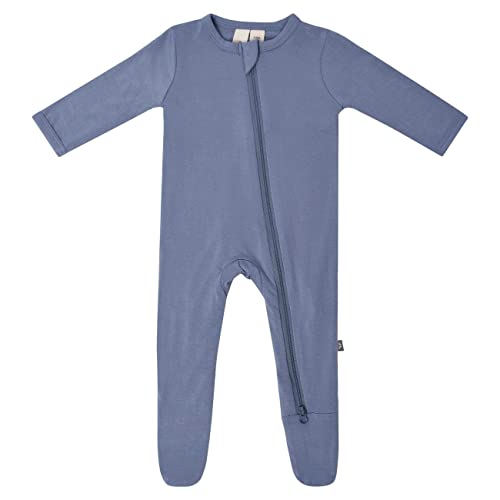
KYTE BABY dual-zip footies
The KYTE BABY newborn footie has attached feet for a covered-foot option.
Check AmazonView design & fit details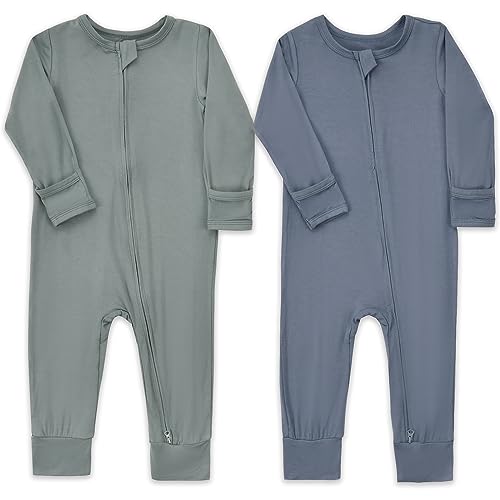
Aablexema footless baby rompers
Aablexema's Olive & Blue rompers are footless; the linked selection is 18–24 months.
Check AmazonView design & fit details
Cabahata convertible baby footies
Cabahata's Dog sleeper is described as a convertible footie in 18–24 months; inspect how its feet open and close.
Check AmazonView design & fit detailsAs an Amazon Associate I earn from qualifying purchases. Purchases take place on Amazon.
The three leg endings you are actually comparing
| Construction | What it means for selection | Detail to resolve |
|---|---|---|
| Attached foot | The garment includes a shaped foot section. | How its foot, leg and torso dimensions work together. |
| Open ankle | The leg ends without a permanently enclosed foot. | Cuff position and any separate foot-coverage decision. |
| Convertible foot opening | A feature is intended to change the foot coverage. | The exact fold, fastening or panel arrangement shown by the manufacturer. |
Read the product description alongside the selected pictures. If a listing mixes footed and footless variants, confirm which one belongs to the exact option you have selected. A group photograph may display both even when the individual item includes only one format. That distinction matters more than whether the family is marketed using the broad word sleeper.
Assess a footie from the torso down
With attached feet, leg length does not end at the ankle. Check the manufacturer’s chart and inspect how the garment lies through the body, the seat and the legs when it is worn as intended. Pulling across the body can transmit tension into the foot section. Looking only at the available toe space misses that relationship.
A useful observation is whether the heel area, if visibly shaped, sits where it is intended rather than rotating away from the foot. Also look for unexpected pulling when the child changes position. These are reasons to reconsider the cut or size with the brand, not reasons to stretch the garment aggressively or leave a closure partly undone to create length.
Do not buy a larger snug-fit sleeper solely to get more foot room. If the relevant size fits poorly in one area, a different design may be a better candidate. Children's sleepwear fit directions constrain the decision. The CPSC expressly permits feet on tight-fitting sleepwear, while retaining dimensional requirements, including at the ankle. An attached foot does not remove those obligations.
Open ankles change one boundary, not every boundary
Footless pajamas separate foot length from the end of the garment. That can make the foot section irrelevant to the fit assessment, but the ankle opening, leg length and body dimensions still matter. A cuff that slides over the foot or excess length that bunches substantially should not be interpreted as useful growth capacity.
Separate foot coverage is a separate decision. Footless does not mean you must automatically add socks for every situation, and the fiber name does not determine the answer. Follow relevant guidance for the child and any other sleep products being used. This comparison concerns pajama construction; it cannot establish a universal temperature or layering prescription.
Convertible feet deserve a closer look before becoming the deciding feature
The word convertible suggests a useful option, but the details vary. Determine where the fold-over material sits in each configuration and whether the manufacturer specifies limits or instructions for using it. Study both states. A photo showing only enclosed feet does not tell you how the garment looks or fits with those panels opened.
Convertible feet may be appealing when you want to vary coverage while retaining the same otherwise appropriate garment. The feature should be evaluated within the period when the complete sleeper fits. It does not justify stretching cuffs, extending wear beyond the chart or regarding the pajama as several sizes in one.
Cabahata’s Dog bamboo-viscose footie lists convertible construction in an 18–24M option. Check photographs of both configurations and the manufacturer’s instructions; “convertible” alone does not show how the change works.
Finding an explicitly footless design
Aablexema’s Olive&Blue romper listings explicitly describe footless construction. Compare their charts with a footed candidate rather than assuming “romper” always means open ankles. For the choice between a joined body and separate bottoms, see one-piece versus two-piece pajamas.
Keep the feature useful through ordinary wear and care
Foot sections can show wear differently from the torso because they occupy a different part of the garment. Inspect seams, fabric and any applied sole features as the item is used. A new hole or loosened component is a condition issue to address, not a reason to improvise a footless version by cutting off the feet.
Modification is especially inappropriate as a casual shortcut for children's sleepwear. Removing a section changes the original garment and its fit. If you want open ankles, purchase an appropriate garment designed that way instead of assuming an altered footie will behave the same.
Questions about this choice
Can I cut the feet off a sleeper that is otherwise usable?
Do not treat cutting as an ordinary conversion for children’s sleepwear. It changes the manufacturer’s design and can affect the leg ending and fit. Choose an appropriately labeled footless garment if that is the format you need, and follow relevant directions for the existing item.
Does a footie title guarantee sole grips on every size?
No. Verify the precise size and design. A product family may describe several features without providing each one on every variant, and a footie is defined by its enclosed foot construction rather than by a grip claim.
Will convertible feet make a sleeper last through several sizes?
The feature changes foot coverage; it does not establish that the torso, arms and legs remain correctly fitted as the child grows. Continue to follow the garment’s actual size chart and fit labels. Treat any longer-use marketing separately from the fit assessment.
Final Verdict
If the foot section is the problem, compare an open-ankle design in the correct size. Cutting the feet off or oversizing the whole sleeper changes more than foot coverage.
As an Amazon Associate I earn from qualifying purchases. Purchases take place on Amazon.