Compare baby-pajama zippers by their opening route, number of sliders and the way fabric is arranged around the fastener. “Two-way” or “dual zipper” is a starting clue, not a full demonstration of operation. Confirm the exact design, practice opening it while empty, and follow its instructions. A zipper feature does not independently prove garment fit, compliance or suitability for a particular child.
The useful zipper question is how much of the sleeper opens for a diaper change. Trace the track and identify what each slider does. A close-up or manufacturer demonstration can explain more than the words “dual zipper.”
As an Amazon Associate I earn from qualifying purchases. Purchases take place on Amazon.
Three options to explore
A dual or two-way zipper can change how you open a sleeper for dressing. Check its route, guards and selected size; the name alone does not establish safer or faster changes. How we choose products.
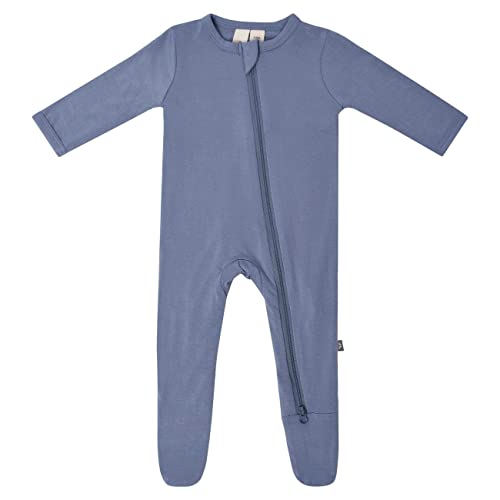
KYTE BABY dual-zip footies
KYTE BABY pairs a dual zipper with the Slate newborn footie.
Check AmazonView design & fit details
PATPAT two-way-zip baby sleeper
PATPAT lists a two-way zipper on this sleeper; confirm the available age size before ordering.
Check AmazonView design & fit details
Little Sleepies Willow Ribbed newborn pajamas
Little Sleepies' Willow Ribbed newborn pajamas include a two-way zipper in a viscose-from-bamboo garment.
Check AmazonView design & fit detailsAs an Amazon Associate I earn from qualifying purchases. Purchases take place on Amazon.
Read the path before counting the pulls
Trace the opening in the product photographs from its upper end to its lower end. Note where it finishes and which parts of the garment remain joined. A front opening that continues toward one ankle creates a different dressing sequence from a short opening that stops higher on the body. Both may be described simply as zippered.
Now identify the sliders. A listing that says one zipper may be referring to the track, while a listing that says dual may be emphasizing two operating points. Manufacturers do not always explain these words with identical detail. Look for a photograph or demonstration showing what happens when each pull moves. Counting visible pieces is less useful than understanding which section becomes accessible.
The central distinction is between removing the entire garment and gaining access to a particular area. A design may let you open the lower part while leaving more of the upper garment closed. That can be convenient for the relevant change, but it is not a guarantee that the baby remains asleep or that every caregiver will find it easier. Evaluate the physical operation rather than the outcome promised by a marketing sentence.
Translate common listings into questions you can actually answer
| Listing phrase | Useful question | What the phrase does not establish |
|---|---|---|
| Dual zipper | Which sections can be opened independently? | A universal slider arrangement or guaranteed faster changes. |
| Two-way zipper | Can the lower opening be used as shown without disconnecting the top? | That another brand operates in the same way. |
| Zipper footie | Where does the opening end around the legs? | A second slider. |
| Zipper guard | Where is the covering fabric located when closed? | A complete absence of rubbing or pinching. |
A close look at guards, backing and the top of the opening
Inspect any fabric backing and covering at the upper end of the zipper. Check how it sits when the garment is closed. CPSC recognizes these functional features in its tight-fitting sleepwear guidance, but a guard alone cannot establish compliance.
Check whether a covering folds out of position while you operate the empty garment. If it does, learn how the instructions tell you to arrange it. Do not add a homemade pad, extra ribbon or improvised attachment to the opening. Children's sleepwear is not an appropriate place to assume that more decorative fabric automatically improves a functional design.
Think about the fastener as part of a seam. Nearby knit fabric can be caught when material is gathered into its path. A flat, visible route is easier to inspect than fabric bunched around the sliders. Keep handling gentle and stop if the mechanism resists; forcing it is not a sensible way to prove that a newly purchased zipper works.
Compare two documented dual-zip designs
KYTE BABY’s Slate footie and Fog romper list dual zippers. Compare where each track ends and which section opens for a diaper change. The word “dual” does not show whether those two garments operate identically.
Practice the sequence on the empty sleeper
Before the garment enters regular use, lay it on a clear surface and follow the supplied operating directions. Open and close it through the intended route. Notice where each pull begins and ends, which parts remain connected and whether any fabric needs to be moved clear. This familiarization is particularly useful when two caregivers are accustomed to different zipper designs.
For a two-way arrangement, understand the normal fully closed position as well as the partial opening. If you cannot restore the sliders to the intended arrangement without struggling, consult the maker's explanation rather than improvising. Some designs may be familiar at a glance, while others are easier to understand from a diagram.
Separate an unfamiliar sequence from abnormal operation. A mechanism that catches repeatedly in the same area, missing components or a damaged track should be raised with the seller or manufacturer. Learning to work around a defect is not the goal of practice. Keep the item unused while resolving a concern that affects ordinary operation.
Protect the mechanism during laundering and storage
Read the complete care label, including instructions about closing fasteners. For the rest of a first purchase, see the newborn pajama guide; zipper access is only one part of choosing a usable sleeper.
Questions about this choice
Do dual-zip and two-way mean the lower end always opens first?
No universal operating sequence follows from those labels alone. Look at the exact manufacturer’s demonstration or directions to understand how its sliders are arranged. The useful feature is the access the design actually provides, not an assumed meaning shared by every listing.
Is a zippered pureborn footie necessarily a two-way design?
The Bread 3–6M listing describes a zipper but leaves the number of sliders unspecified. Check the selected product’s photographs or ask the seller whether it opens from both ends.
Should I keep pulling if fabric catches beside a baby-pajama zipper?
Stop rather than force the slider. Resolve the trapped material carefully with the garment in an appropriate position and consult the manufacturer if operation remains abnormal. Persistent catching or damaged components should be addressed before the sleeper is used again.
Final Verdict
Practice on the empty garment until the opening sequence is familiar. A sticking or damaged mechanism needs resolving before use, not a faster pull.
As an Amazon Associate I earn from qualifying purchases. Purchases take place on Amazon.