A conservative starting estimate is (days between washes + drying time in days) × fresh outfits used per day, rounded up, plus your chosen spares. Subtract usable garments already owned to find the shopping gap. Count tops and bottoms separately if you change them at different rates. This is a household planning estimate, not a required wardrobe size or a rule about daily changing.
Six garments do not always make three usable pajama outfits. You might have four tops and two bottoms, one of the bottoms may still be drying, and only one top may fit well. A useful rotation starts with clothing that is actually ready to wear. From there, a few simple calculations can show what you need without turning pajama shopping into an arbitrary target count.
As an Amazon Associate I earn from qualifying purchases. Purchases take place on Amazon.
Three options to explore
Count the clean outfits you need between washes, then fill the missing pieces. A pack of tops, a pack of bottoms and baby sleepers are different purchases, regardless of the number in each pack. How we choose products.

Latuza men’s sleep-shirt three-pack
Latuza supplies three men's short-sleeve tops if shirts are what your rotation lacks.
Check AmazonView design & fit details
Esenchel plus-size sleep-pants two-pack
Esenchel's plus-size pants two-pack adds bottoms only; check the selected size against the wearer's measurements.
Check AmazonView design & fit details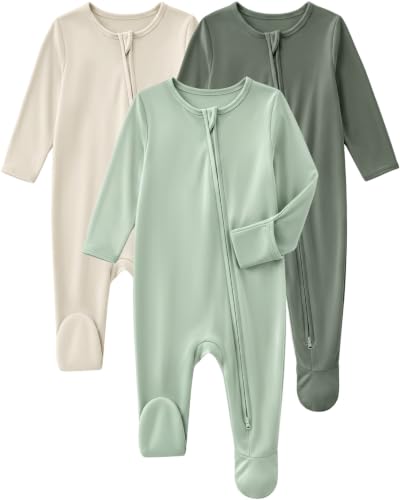
Yoofoss footed-sleeper three-pack
Yoofoss supplies three footed sleepers in the linked 0–3 Months selection; confirm fit and sleepwear labeling before counting them into a baby's rotation.
Check AmazonView design & fit detailsAs an Amazon Associate I earn from qualifying purchases. Purchases take place on Amazon.
Count complete, usable outfits
For an adult, count a clean, comfortable top and bottom as one outfit, or one nightgown. Exclude garments waiting for repair and pieces that no longer fit. For separates, count each type so a surplus of tops does not hide a shortage of bottoms.
For a baby, count the actual sleepwear units the responsible adult uses in the routine, with each garment appropriately sized and selected. A three-pack of one-piece sleepers gives three units only if all three fit and are ready. A four-piece package may contain two tops and two bottoms rather than four complete outfits. Package quantity and wearable-outfit quantity are different measures.
Allow for the wash interval and drying time
For a conservative starting estimate, add the days between washes to the time a washed set takes to become wearable again. Washing every three days with one day of drying gives a four-day coverage window. This allows for a set worn just after a wash that waits for the next load and then dries; it does not mean regularly scheduled clean batches arrive four days apart. A household that staggers garments carefully may manage with fewer.
Calculate the routine demand first
Count the outfits used before the next clean batch is ready, then add your chosen spares. At one change a day with a four-day coverage window, four outfits cover that estimate and one spare makes five. This example shows the arithmetic; it is not a rule to change adult pajamas daily. Enter your own schedule in the laundry rotation planner.
If your own adult routine uses a pajama for more than one wearing before laundry, calculate the demand from that practice and the garment’s condition. For example, three outfits might cover six nights in a household choosing two wearings per outfit, before adding any spare. This is arithmetic based on a stated assumption, not advice that every wearer should rewear sleepwear for a fixed number of nights.
| Illustrative routine | Routine demand | Chosen spare | Planning total |
|---|---|---|---|
| Adult: one outfit per night, three-night coverage window | 3 | 1 | 4 outfits |
| Adult: one outfit used for two nights, six-night coverage window | 3 | 1 | 4 outfits |
| Baby household: two changes per day, two-day coverage window | 4 | 2 | 6 appropriately selected units |
| Adult tops: one per day, four-day interval | 4 tops | 1 top | 5 tops, bottoms calculated separately |
Let tops and bottoms have different jobs
If you change tops more often than bottoms, count each separately. Otherwise, buying complete sets can leave you with surplus pants and too few tops. Our guide to separates covers that purchasing choice.
Suppose a person’s four-day routine uses four tops and two bottoms, with one spare of each desired. The planning target is five tops and three bottoms. Buying five full sets would produce two additional bottoms beyond that stated need. Separately available pieces can solve the actual gap more precisely, assuming the combinations are ones the wearer likes.
Use a short observation period for a baby household
When change frequency is unpredictable, record actual use over several ordinary days. Note how many sleepwear units were used, how many were waiting for laundry, and when clean replacements became available. This provides a household-specific basis for planning instead of borrowing someone else’s required-count claim.
Keep the size boundary firm. The CPSC describes specific requirements and conditions for infant garments and tight-fitting sleepwear. Use the exact garment’s size guidance and required labeling. Do not inflate the usable wardrobe count by treating oversized snug-fit pajamas bought for later as current spares. A future-size garment is stored inventory, not necessarily an appropriate outfit for tonight.
Add a delay buffer where the routine actually breaks
A household that can start laundry immediately after an extra change may need a different buffer from one using a shared machine once a week. Think about the likely interruption: a missed laundry slot, a slower drying period, travel, or a garment temporarily out of use. The spare should cover the interruption you want to tolerate without stress.
You can express the buffer as outfits or as time. If one additional day of delay means two more changes in your own routine, a one-day buffer corresponds to two units. That is clearer than assigning every household the same spare number. It also helps decide whether improving the laundry schedule or purchasing another piece is the more useful solution.
A sensible purchase fills the difference between dependable current capacity and the target your own assumptions produce. If the target is four complete outfits and three suitable ones are already ready for rotation, the gap is one—not four. Start there, then reassess after ordinary use. Counting this way keeps the wardrobe functional without treating a large drawer as the goal.
Check whether your drying space can handle the rotation
More pajamas can bridge a delayed load, but they do not create more drying space. If the care label calls for flat drying, check how many garments your available surfaces can accommodate. A smaller suitable load more often may be easier to manage than washing every long set at once. Mark pieces awaiting repair or no longer fitting as unavailable before calculating the shopping gap.
Questions about this choice
Do I count pajamas that are drying as part of the clean spare supply?
Treat drying garments as temporarily unavailable. The planner adds wash spacing and drying time to estimate a conservative coverage window; it does not assume clean batches in a steady laundry schedule arrive that many days apart.
How do I calculate a rotation when I change tops more often than bottoms?
Calculate top demand and bottom demand independently, then add the spare allowance you want for each. Check that the pieces form combinations you will wear. This may lead to buying additional tops instead of more complete sets.
Should next-size baby pajamas count toward the number needed now?
Keep them separate from the current usable count until the exact garment fits appropriately and meets its intended use and labeling requirements. In particular, do not treat oversized snug-fit sleepwear as a present spare. Stored future clothing and ready-to-wear capacity serve different purposes.
Final Verdict
Subtract suitable garments already owned from your calculated rotation. Buy that gap, counting tops and bottoms separately when you use them at different rates.
As an Amazon Associate I earn from qualifying purchases. Purchases take place on Amazon.