Choose a button-front pajama top when opening the front is valuable and you do not mind a placket against your body. Choose a pullover when you prefer an uninterrupted front and can comfortably put it over your head. Compare chest room, neckline and armholes before deciding: the opening alone does not tell you whether a particular top will fit well.
Opening a shirt down the front avoids pulling it over your head. It also adds small fasteners and a thicker strip of fabric against your torso. Those are the two tradeoffs to try before choosing your preferred pajama top.
As an Amazon Associate I earn from qualifying purchases. Purchases take place on Amazon.
Options for this specific choice
Start with how you prefer to put a top on: fastening a front or pulling a neckline over your head. These examples also differ in wearer and coverage, so they are not equivalent outfits. How we choose products.
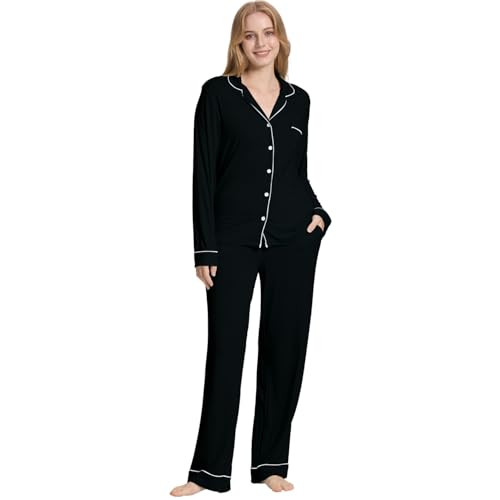
TOSMO long-sleeve pajama sets
TOSMO's women's set has a long-sleeve button-down top for a front-opening choice.
Check AmazonView design & fit details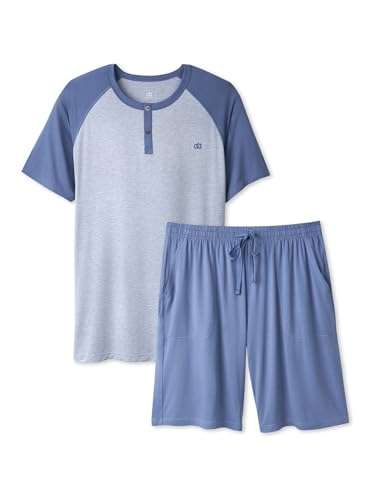
DAVID ARCHY men’s T-shirt and shorts set
DAVID ARCHY pairs a men's T-shirt with shorts for the pullover side of the comparison.
Check AmazonView design & fit detailsAs an Amazon Associate I earn from qualifying purchases. Purchases take place on Amazon.
Start with the movement you want to avoid
Picture putting on the top, rather than standing still in its product photograph. A pullover usually involves moving your arms into position and bringing the neckline over your head. The exact motion varies with the cut: a broad neck and generous armholes behave differently from a narrow crewneck on a close-fitting body. Stretch may help, but a listing that simply calls a fabric stretchy does not tell you the usable opening circumference.
A fully opening button front lets you put your arms through the sleeves and close the garment in front of you. That can be a practical preference when overhead dressing feels awkward. It also introduces several small fasteners. If manipulating small buttons is the difficult part of dressing, replacing an overhead movement with six or seven separate fastening tasks may be an unhelpful trade. Look closely at the button scale and the amount of fabric surrounding each buttonhole.
The placket is a structure, not just decoration
The placket is the reinforced strip carrying the buttons or buttonholes. It creates a different area of the top from the single layer beside it. Someone who dislikes objects or folded edges under the torso may prefer the plain front of a pullover, particularly when lying partly face down. Another person may hardly notice the strip but care strongly about having an adjustable neckline.
Inspect how far the opening extends. A short buttoned neckline is a henley-style opening, not the same as a shirt that opens to its bottom hem. A few neckline buttons may make a top easier to pull on and change the amount of upper-chest coverage; they do not let the two front panels separate completely. Product titles sometimes emphasize buttons without making this distinction clear, so the front and side photographs matter.
Check a buttoned top while seated and reaching forward. If the edges pull apart, investigate front width rather than simply leaving a button undone. The fuller-bust guide goes into placket tension and front hem lift.
Button-front options
Ekouaer and Joyaria list bamboo-viscose button-front sets; Latuza lists men’s button-down pajama shirts separately. For any candidate, distinguish a full opening from a short neckline placket before ordering.
Wearing a collar under another layer
For someone who frequently adds and removes a cardigan or robe, the pajama collar can affect layering. A flat pullover neckline usually leaves less material near the outer collar, while a pajama shirt's collar may need arranging. That is a garment-layering observation, not a reason to dismiss collars. Try the candidate shape under the layer you actually wear at home.
A practical two-top comparison
If you already own a buttoned shirt and a sleep T-shirt, use them to identify the issue before shopping. Note which part you adjust most often: neckline, front opening, sleeve, shoulder or hem. A top that repeatedly needs tugging may have a length or proportion problem that another closure will not solve. Record the measurements of the better-fitting garment as a reference, without assuming the new fabric will behave identically.
Then compare two candidates with reasonably similar coverage. A long-sleeve buttoned set against a sleeveless pullover set mixes too many variables to reveal a closure preference. A crewneck long-sleeve top and a button-front long-sleeve top make a more meaningful comparison. Keep bottom length out of the decision until the opening and upper-body fit make sense.
Check the fastenings before the first wash
On a button-front top, inspect the button attachments, holes and inside placket edge before removing tags. Follow the garment’s care label, including any directions for fasteners. A pullover removes that set of components, but its neckline and knit still need the prescribed care. Choose between the openings for dressing and comfort; neither one supplies a universal washing method.
Questions about this choice
Does a henley pajama top open like a button-front shirt?
Usually the comparison is different: a henley has a partial neckline opening, while a full button-front shirt opens down the torso. Verify the actual design. A partial opening can change neckline access and coverage, but it normally still requires putting the garment over the head.
Should I choose matching buttons on the top and bottoms?
There is no functional need for matching closures. A buttoned shirt can work with elastic-waist sleep pants. Focus on how each piece dresses and fits independently; decorative coordination is secondary to avoiding an uncomfortable front fastening or a waistband you keep adjusting.
Can a collarless button-front top split the difference?
Yes, when an exact garment offers it. Removing the folded collar can reduce material around the neck while retaining front access. It does not remove the placket or buttons, so someone specifically bothered by those parts should still consider a plain-front top.
Final Verdict
Try the dressing motion and your usual resting posture. Buttons are useful only if front access matters more to you than the fastenings you will feel at night.
As an Amazon Associate I earn from qualifying purchases. Purchases take place on Amazon.